|
2800
Class History Notes
Queensland
Railways commenced a Main Line Upgrade program for the North
Coast Line from Brisbane to Cairns in 1992 which included
re-alignment of some of the worst sections of track and track
upgrades to accommodate a 20-ton axle load, as well as lifting
the permissible speed limit for freight trains from 80 km/h to
100 km/h.
New
container wagons were ordered as part of this upgrade as well
as a requirement for the supply of 40 new locomotives.
The tender for the construction and supply of the new
locomotives was awarded to A.Goninan & Co Limited with
construction of the locomotives to take place at the Goninan
(North Queensland) facility at Bohle, Townsville.
The new locomotives were to be known as the 2800 Class
feature a Co-Co axle arrangement and a weight of 116 tons. The
2800 Class utilized the latest General Electric technology in
the form of Dash 8 units and were a narrow gauge version of
the US standard 3,000 horsepower C30-8.
The 2800 Class was to be the first application of this
GE technology into a narrow-gauge locomotive and were
designated model CM30-8 by Goninan.
Running numbers for the first contract of 2800’s was
2801 to 2840.
The
2800 Class was built to the maximum height and width limits of
the Queensland loading gauge and feature full width
air-conditioned cabs on both ends to enable driver only
operation in either direction without the need to turn the
locomotive.
Originally their intended operating sphere was
from Rockhampton to Cairns, but during the currency of the
initial contract, a further 10 (running numbers 2841 to 2850)
were ordered to allow the class to be utilised on the
Townsville to Mount Isa line which had also received an
upgrade to a 20-ton axle load.
All
50 of the 2800 Class were intended for use on passenger,
freight and mineral workings.
2801 was delivered in September 1995, and the last to
be delivered was 2850 in August 1998.
Forty
of the class were in traffic by 1997 and had a major impact in
QR operations at the time.
Their four stroke engines made a noticeable saving in
diesel fuel, and the amount of freight train double heading
was slashed. They also managed high availability, many running
over 10,000 km per month.
Use of the class on passenger train workings ceased in
1998 due to smoother power supply and acceleration provided by
other locomotives available in the QR fleet at the time.
The
operating area of the 2800 Class was expanded further south in
1997 when the first of the class was trailed to Brisbane.
This trial was made difficult due to suburban clearance
issues as the locos tended to move sideways on their
suspension, resulting in random fouling of platforms and other
infrastructure. This required extensive modifications to be
made with a retrofit program undertaken in 1998. Specific
tracks were subsequently cleared for use by the class into
Brisbane. Regular operations to Acacia Ridge and Fisherman’s
Island on intermodal services commenced in April 2000.
All
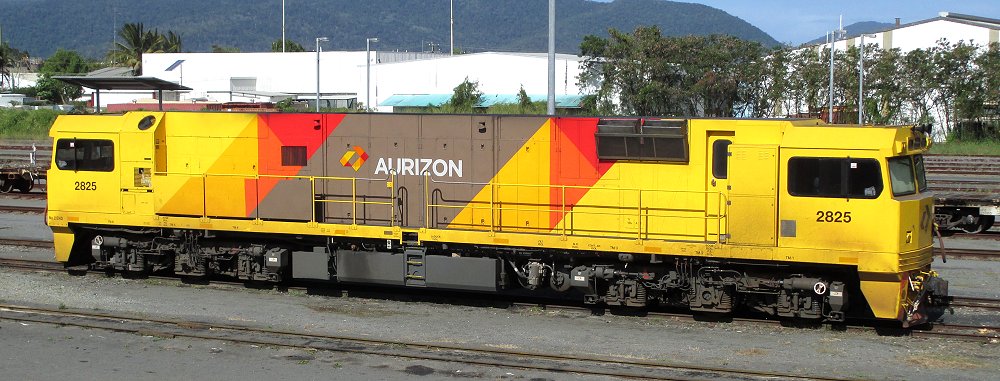
fifty 2800 Class locomotives were transferred to Aurizon
ownership in 2010.
In
2025 the class remains in regular use on North Coast line
freight services, Mount Isa line mineral/bulk freight services
and occasionally on Aurizon Network Central Queensland Coal
Network (CQCN) infrastructure train duties.
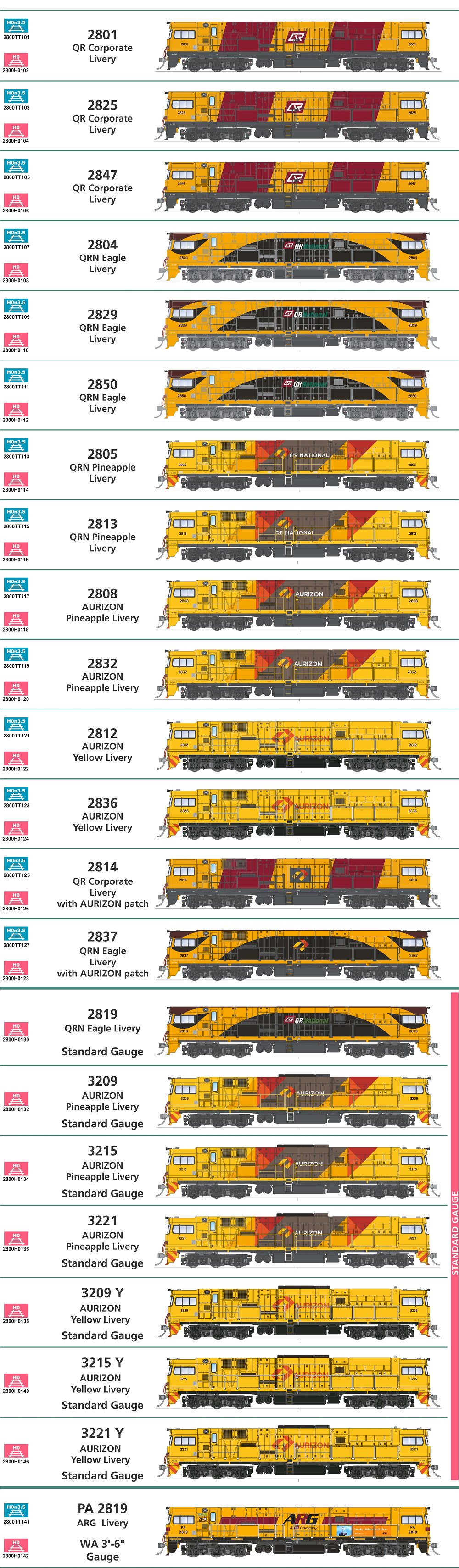
In
January 2006, 2819 was converted to standard gauge for use on
QR National Intermodal services, using new bogies supplied by
its original manufacturer. At the time 2819 considered as a
prototype for further standard gauge conversions.
However, the trial was not a great success for 2819 in
its new role.
2819 was trialled in different areas before finishing
up on the Melbourne to Adelaide corridor, including Adelaide
support use.
In August 2009, 2819 was transferred to Australian
Railroad Group (ARG) in Western Australia where it was
subsequently converted back to narrow gauge by UGL.
Reclassed as PA 2819 by ARG, it entered service at Avon
in July 2010.
PA 2819 has been mainly used in the south-west of the
state since its entry into WA service, along with some
short-term use on Albany woodchip workings.
In
2012, three further units (2815, 2821 and 2809) were converted
to standard gauge, for working the domestic Duralie coal
traffic in the Hunter Valley region of NSW. Existing locos
used in this traffic were considered too noisy, with the
converted 2800 class receiving extra muffling for the task.
Following completion of overhauls at Redbank Workshops, the
three locos were road hauled to NSW for recommissioning. 2815
was commissioned at Chullora, the other two at Broadmeadow.
When first introduced to standard gauge operations in NSW,
2815, 2821, and 2809 were referred to as 28 Class locomotives
by Aurizon.
These locos are higher in standard gauge form, with a
68mm spacer added to the bogie pivots, and a muffler enclosure
on the top of the hood. Weight was 118 tonnes. Operations
commenced gradually from the end of January 2012 using 2815,
with all three in service by August
However,
an ARTC Waiver was withdrawn for the class in September 2012,
effectively precluding their use in the state of NSW. They
were subsequently transferred to Intermodal for use in
southern states and were used in either Melbourne or Adelaide
in support roles. 2815 returned to UGL at Broadmeadow at the
end of January 2013, and was fitted with a new muffler, which
was able to pass EPA testing. On 2 July 2013, ARTC approved
the operation of the locos in NSW, with a new class 3200
assigned. 2815 was renumbered 3215, with the other two
becoming 3221 and 3209. 3215 entered service in Duralie
traffic on 28 October, with the other two in following weeks.
However, their operations were not a great success and were
replaced by extra 6000 class in December 2014.
The
three 3200 Class locos were retained for coal support work and
also used in NSW grain traffic up to the end of 2017.
In January 2022, 3221 was transferred from coal
operations to grain operations once again, followed by 3215 in
September 2023.
In October 2024 3221 went on short-term lease to
Progress Rail for Manildra haulage. In
2025 all three 3200 Class continue to operate for Aurizon.
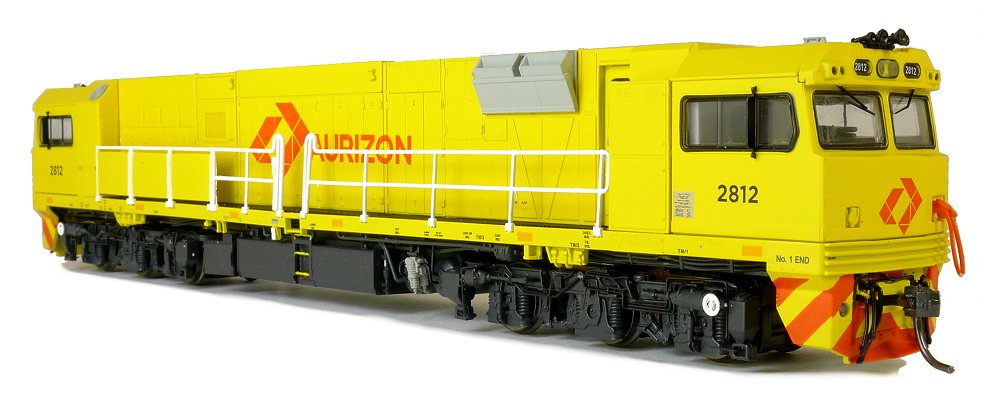
These models have been produced
with invaluable research and development provided by CGL
Models.
|